
What Is iCal Sync for Vacation Rentals?
iCal sync for vacation rentals is a way to keep booking calendars aligned across listing platforms by exchanging calendar links in the .ics format, without paying for a channel manager or setting up an API connection. Each platform generates a link that another platform imports, so a reservation on one calendar blocks the same dates everywhere that link is connected.
How iCal Sync Works
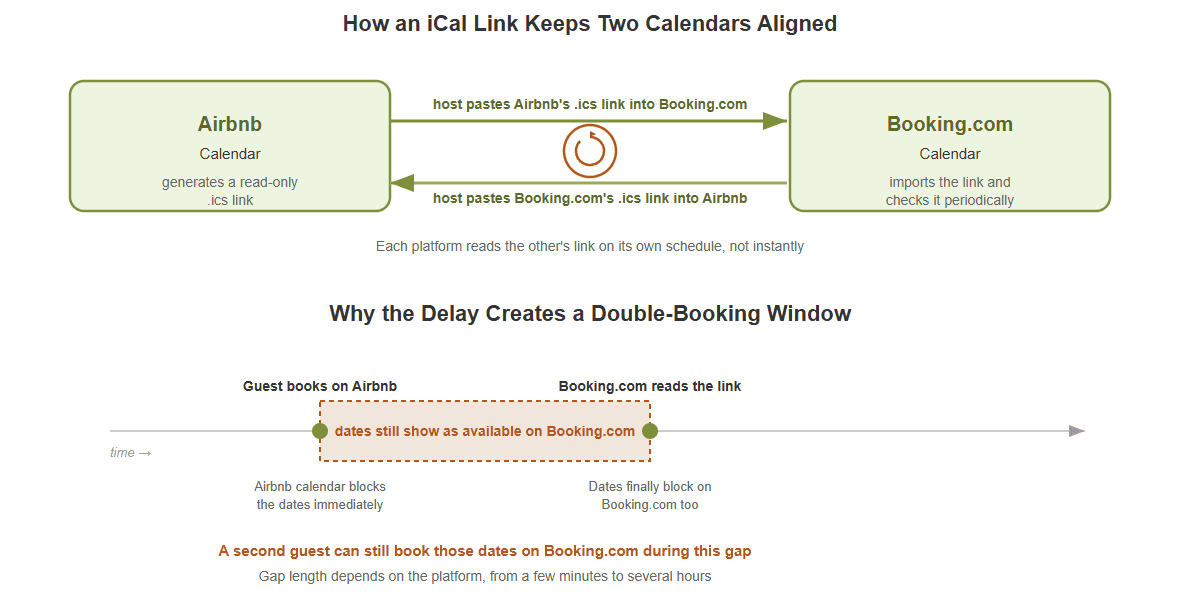
Setting it up means generating an export link from one platform and pasting it into another platform’s import field, then repeating the process in the other direction so both calendars block each other. Each side checks the other’s link on its own schedule instead of receiving a live push, so an update only lands the next time that platform happens to look. Airbnb, Booking.com, and other listing sites each run this check at a different pace, so the same setup can update in minutes on one side and take hours on the other. Because .ics is a general calendar standard rather than something built for vacation rental platforms, the same link also works with a personal calendar app like Google Calendar, Apple’s Calendar app, or Outlook, if a host would rather see bookings there instead of on another listing site. Dedicated calendar-sync tools can handle this pairing automatically for hosts connecting several platforms, generating and exchanging the links without manual copying, but the connection underneath is still iCal, so the delay and double-booking risk described below apply just the same.
What travels through an iCal link is narrow by design. A calendar feed communicates which dates are booked or blocked and little else, not your nightly rate, minimum stay rules, listing photos, or guest details. Change your price on one platform and that change still has to be entered everywhere else by hand, since iCal sync has no way to carry it across.
iCal Sync and the Double-Booking Risk
Because each platform pulls the calendar on its own timer rather than getting updates instantly, there’s always a gap between a booking landing on one platform and that date disappearing from the others. How long that gap lasts depends entirely on the platform involved, and it can run anywhere from a few minutes to several hours. Holidu, for instance, quotes delays of up to 15 minutes on its Airbnb iCal connections. A guest browsing a different platform during that window can still book the same dates, which is the core risk iCal sync carries that a live API connection avoids.
A few other issues show up in practice beyond the delay itself. Calendar links can expire or get regenerated when a platform updates its systems, which breaks the sync quietly until a double booking actually happens. Time zone mismatches between platforms can shift blocked dates by a day. And a date you block manually in one calendar, say for your own use, can get overwritten the next time that platform’s link is read if the same block wasn’t also entered on the source calendar. Smoobu, for instance, treats itself as the one place blocking happens and doesn’t import manually blocked dates from connected OTA calendars at all, a stricter version of the same problem. It’s also worth checking that a link runs in both directions. If only one platform actually imports the other’s calendar, blocks only ever travel one way, and the setup isn’t protecting you the way most hosts assume it does.
iCal Sync vs. Channel Manager
iCal sync costs nothing beyond the time it takes to set up, which makes it the obvious starting point for hosts running one or two listings, or a way to cover the platforms a paid channel manager doesn’t reach. Holidu, for example, lets hosts add unlimited extra platforms this way once its direct integrations are used up, though the tradeoff is the same delay and availability-only sync described above. Lodgify handles the same situation for any platform outside its own API connections. A channel manager works differently. It runs on a direct API connection instead of a calendar file, updates within seconds rather than minutes or hours, and keeps rates and listing content in sync alongside availability, usually for a subscription or commission fee. Most hosts outgrow plain iCal sync once they’re juggling more than two or three platforms or taking bookings often enough that the delay stops being theoretical.
