
What Is a Channel Manager?
A channel manager for vacation rentals is software that automatically keeps your availability, rates, and bookings in sync across multiple listing platforms such as Airbnb, Booking.com, and Vrbo. It connects to each platform through a direct two-way link, so a reservation made on one channel instantly blocks those dates everywhere else.
How the Sync Actually Works
Most channel managers run on an API connection rather than a calendar file. An API connection pushes your rates and availability out to every platform and pulls booking confirmations back in, usually within seconds. An iCal sync, by contrast, only exchanges calendar dates in one direction and can lag behind by anywhere from fifteen minutes to two hours, long enough for two guests to book the same dates on different platforms before either calendar catches up.
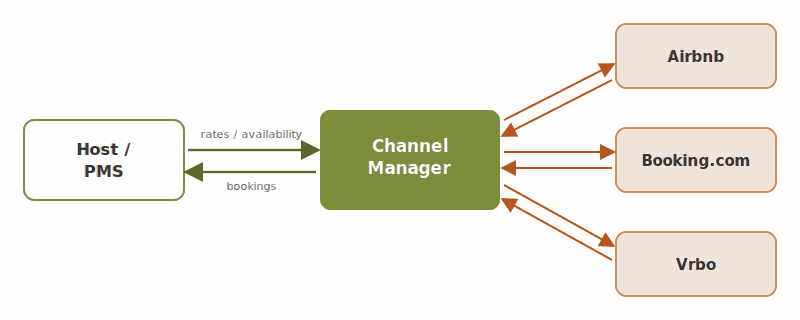
Not every connected channel gets the same treatment, and this is where hosts often get caught out. Some channel managers reserve full two-way sync, meaning availability, rates, fees, and even guest messages, for their one or two biggest partners, typically Airbnb and Booking.com, while smaller or regional portals receive only basic availability and rate updates through the same API. A few tools even mix sync speeds within a single setup: one connected channel can update the moment a booking comes in, while another only refreshes once an hour. That hourly gap is a real double-booking window, the exact risk a channel manager exists to close. If preventing double bookings is the problem you’re trying to solve, it’s worth checking how fast each of your specific channels actually syncs, not just whether the platform lists that channel as connected.
Which Platforms Can a Channel Manager Actually Connect To?
The number of platforms a channel manager can actually reach varies more than the marketing pages suggest, and it’s a different question from how deep each connection goes. Smoobu connects to Airbnb, Booking.com, Expedia, Agoda, Trip.com, HomeToGo, and regional platforms like BestFewo and Feratel, but despite covering the largest OTAs directly, it has no API connection to Vrbo, Google Vacation Rentals, Holidu, or HomeToGo. Holidu connects to 15 to 28 platforms depending on your region, including several regional portals it operates itself, such as ferienwohnungen.de, Gites.fr, Clubrural, Spain-Holiday, and Sportihome. If a specific regional or niche portal matters for your listings, checking that exact channel’s availability, rather than the total count a provider advertises, is worth doing before you commit. Our Smoobu review and Holidu review list the full channel breakdown for each.
Channel Manager vs. Property Management System (PMS)
A channel manager is not the same thing as a property management system (PMS), even though the two get bundled together often enough that the line blurs in practice. The channel manager’s job is distribution, keeping your listings synced with the outside world. A PMS handles what happens after the booking lands: guest messaging, cleaning schedules, invoicing. Plenty of tools combine both in a single subscription, so this distinction matters more for understanding what you’re paying for than for picking separate products.
One Login or Many? Two Ways Channel Managers Handle Your Listings
Channel managers also differ in a way that has nothing to do with which platforms they connect to and everything to do with who owns the listing afterward. Some tools keep your existing account on each booking platform in place. Your Airbnb listing stays your Airbnb listing, Superhost status included, and the channel manager just keeps its calendar, rates, and photos synced in the background. Others move your listings onto their own account entirely: you manage everything from one dashboard, but your listing then appears under the software provider’s name on Airbnb or Booking.com rather than your own, and status tied to an individual host profile doesn’t carry over. Neither approach is universally better, but it’s worth deciding on deliberately rather than discovering it after you’ve already switched. Our Smoobu review and Holidu review walk through exactly how each handles this.
What a Channel Manager Typically Costs
Pricing generally follows one of two models.
Subscription
- Fixed fee per property, per month
- Cost stays the same no matter how many bookings come in
- Usually cheaper for higher-priced or higher-occupancy listings
- You pay it whether or not you get bookings that month
Commission
- Percentage of each completed booking, usually a low to high single-digit rate
- No fee until a booking actually happens
- Can suit lower-priced listings or hosts who’d rather avoid a fixed cost
A few tools blend both, charging a base subscription plus a smaller fee for specific add-ons like dynamic pricing. Which model actually costs less depends on your nightly rate and occupancy, not on which tool has the lower headline price.
Setting Up a Channel Manager (And Switching From Another Tool)
Getting started varies by provider too, and setup matters most if you’re migrating from a spreadsheet or another tool without wanting a double booking mid-switch. Smoobu’s onboarding is self-service with no setup fee and a 14-day trial to test the platform before paying, plus a property import directly from your Airbnb account to speed up migration. Lodgify pairs a demo or onboarding call, often available the same day, with hands-on help configuring channels, automation, and a booking website, and also imports existing listings from Airbnb. Holidu, by contrast, charges a separate onboarding fee on top of its subscription. None of this replaces manually double-checking your synced calendars in the first few days after a switch, since an import speeds up setup but doesn’t guarantee every channel is fully connected from day one. Our Lodgify review and Smoobu review cover each onboarding process in more detail.
Dynamic Pricing and Other Add-Ons
Several channel managers connect to a dynamic pricing tool, or include one directly, that automatically adjusts your rates based on demand, seasonality, and how comparable listings nearby are priced, then pushes the updated rate out through the same sync that handles your availability. Whether that’s included, an add-on with its own fee, or something you connect separately through a marketplace of third-party integrations varies by provider. It’s worth checking which of your connected channels the updated rates actually reach in real time versus which ones only get the update after a delay.
Where a Channel Manager Fits Among Your Other Tools
A channel manager rarely operates alone. It usually sits alongside a booking calendar you check daily, connects to the same online travel agencies a direct booking website might also pull availability from, and for the channels it doesn’t cover, hosts often fall back on a plain iCal sync as a lighter-weight substitute. Smoobu, Holidu, and Lodgify all build channel management into a broader property management system, but each makes different tradeoffs on channel depth, account ownership, and pricing model, which is exactly what our reviews of each test in practice.
