
What Is Dynamic Pricing for Vacation Rentals?
Dynamic pricing for vacation rentals is an automated system that adjusts your nightly rates based on demand signals like seasonality, competitor pricing, and how far ahead a guest is booking, instead of rates you set once per season and rarely touch. Most tools combine algorithm-driven suggestions with minimum and maximum limits you set yourself, so the system adjusts rates within boundaries you control.
How Dynamic Pricing Works
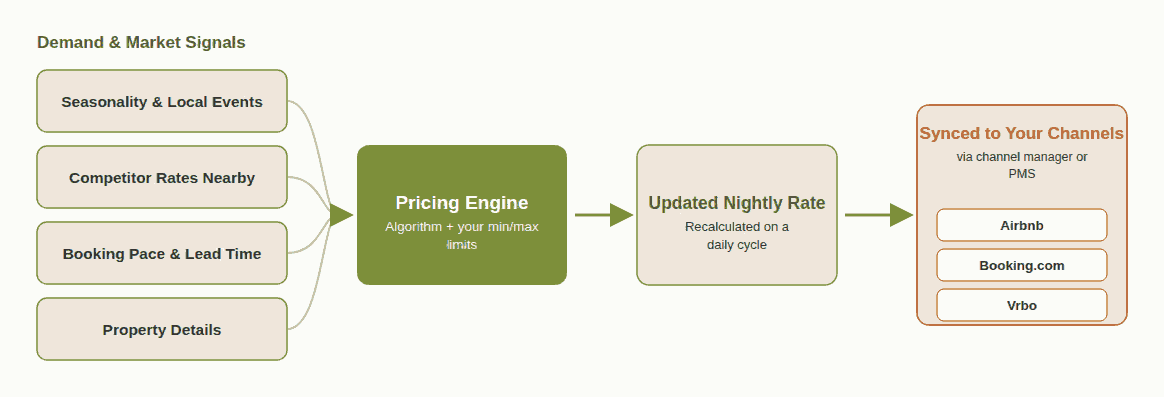
The factors behind a price recalculation are fairly consistent across tools: how far in advance a guest is booking, day of the week, local events and school holidays, how quickly a listing’s calendar is filling compared to the same period last year, and what comparable listings nearby are currently charging. Some systems also weigh the property’s own attributes, like size or amenities, when suggesting a rate. None of this runs on a single fixed formula. Most providers describe it as pattern recognition across historical booking data rather than a simple if-then rule, closer to a forecasting model than a lookup table.
In practice this is a hybrid, not full automation. You set a minimum and maximum nightly rate, and the algorithm proposes prices inside that range rather than overriding it. Most tools also let you override an individual suggested rate by hand for a specific date without switching the feature off entirely. Marketing pages tend to describe the process as happening in real time, but most tools actually recalculate and push new rates once per day rather than continuously, so a booking made an hour ago on a competitor’s listing typically doesn’t move your price until the next daily run. For hosts deciding whether to turn dynamic pricing on, that daily-cycle reality is often more relevant than the real-time claim.
Native, Add-On, or Third-Party Dynamic Pricing Tools
Vacation rental tools handle dynamic pricing three different ways. Some build it in as a free, native feature, the way Airbnb’s own Smart Pricing does for individual Airbnb listings. Others make it a native feature with its own fee: Lodgify‘s dynamic pricing charges 0.8% of each completed booking on top of the subscription, while Smoobu prices it as a separate add-on at €12.99 per property per month, with a choice between rule-based control or three data-driven strategies. A third option is a standalone specialist tool like PriceLabs, Beyond Pricing, or Wheelhouse, run outside your channel manager or PMS entirely and connected through a marketplace integration so its rate output still reaches your synced channels. Not every provider offers dynamic pricing at all: Holidu relies on manual pricing seasons plus a fixed set of discount rules instead, trading the automation for more direct control over every rate change, though it still surfaces competitor rates and regional demand trends on an interactive map so hosts can make those manual decisions with data instead of guesswork.
A channel manager only distributes whatever rate dynamic pricing calculates. It doesn’t do the calculating itself, and how quickly a new rate actually reaches a listing depends on the same sync speed and per-channel gaps that affect any rate change, not something specific to dynamic pricing. Not every connected channel receives the updated rate the same way either: on Smoobu, for example, automatic rate sync applies mainly to Airbnb and Booking.com, and channels with weaker API support still need the new price entered manually in that platform’s own extranet.
Dynamic Pricing vs. Revenue Management
Dynamic pricing is often used interchangeably with revenue management, but the two aren’t the same thing. Revenue management is the broader discipline: setting a pricing strategy, deciding which channels to prioritize, and setting minimum-stay rules, with automating the nightly rate itself as just one part of it. Dynamic pricing is the automation piece inside that larger strategy, not a replacement for it. A host can run dynamic pricing without doing any deliberate revenue management, and the rates it produces will reflect that.
What Dynamic Pricing Costs
Cost follows the same three-way split as the tool itself. A feature bundled for free adds nothing to your bill. A native paid add-on typically runs as either a flat per-property monthly fee, the way Smoobu prices its at €12.99, or a commission on completed bookings, the model Lodgify uses at 0.8%. Third-party specialist tools are priced separately from your channel manager or PMS entirely, usually as their own monthly subscription. Several providers advertise double-digit revenue gains from switching dynamic pricing on, figures worth treating as marketing claims from an interested party rather than a guaranteed result for your specific property. Which model works out cheaper also depends on the property: a per-booking commission tends to cost less for lower-priced, higher-occupancy properties, while a flat monthly fee often ends up cheaper once nightly rates climb or occupancy drops, roughly the 70% mark Lodgify itself uses to recommend switching to a flat-fee alternative.
